
1. Introduction
We are pleased to report the successful conclusion of the online CDNL conference convened on 17 November 2025. The meeting gathered representatives from over 60 national libraries across all world regions, underscoring the global scope and institutional diversity of the CDNL community.
The conference centred on the theme “When collections are threatened: leading national libraries in difficult times”. The session was presided over by Dr. Tomasz Makowski, newly appointed CDNL Chair and Director General of the National Library of Poland, who hosted the proceedings from Warsaw, Poland. He was accompanied by new Vice Chairs: Chinwe Veronica Anunobi, National Librarian and Chief Executive Officer of the National Library of Nigeria and Taner Beyoğlu, Director-General for Libraries and Publications, The National Library of Türkiye.
2. Key Objectives and Agenda
The event focused on the following key objectives:
- Sharing knowledge and building relationships between participants;
- Facilitating candid discussions and thoughtful participant involvement.
The agenda included the following sessions:
- Keynote One by Prof. Peter Stone, President of Blue Shield International,
- Keynote Two by Dr. Robert Glasser, former UN Special Representative of the Secretary General for Disaster Risk Reduction,
- Keytnote Three by Oleg Serbin, Director of the Yaroslav Mudryi National Library of Ukraine,
- Q&A sessions with the keynote speakers,
- Small group breakout discussions focussed on attendees’ experiences,
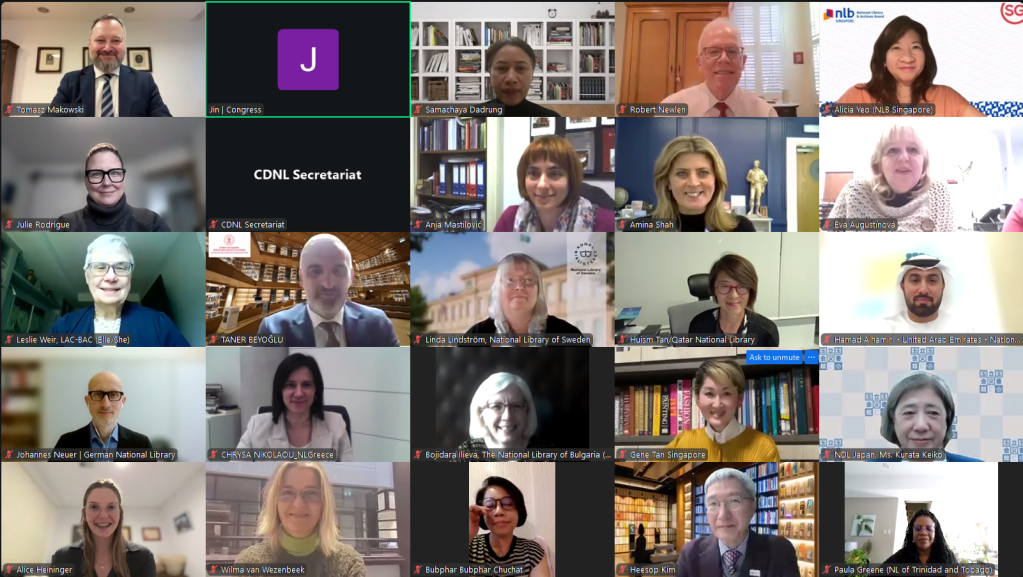
- Group Zoom photograph
3. Event Highlights:
3.1. Keynotes
Three keynotes were provided during the event:
- Prof. Peter Stone, President of Blue Shield International, presented an overview of the mission, evolution, and current activities of the Blue Shield — the international organisation dedicated to protecting cultural property in situations of armed conflict and disaster. Prof. Stone emphasised why cultural property matters: it provides communities with identity, dignity, belonging, and a vital connection to the past. He outlined the main risks to cultural heritage — from lack of awareness and insufficient planning to deliberate targeting, looting, misuse, neglect, and collateral damage. Prof. Stone also highlighted recent and ongoing Blue Shield initiatives, He stressed that effective cultural property protection must be a peacetime activity, requiring extensive preparation, partnerships, legal frameworks, and realistic evacuation planning.
- Dr. Robert Glasser, former UN Special Representative of the Secretary General for Disaster Risk Reduction, outlined defining characteristics of the new climate era, emphasizing that national libraries must prepare for a rapidly changing risk environment with no historical precedent. He highlighted that climate impacts are accelerating at a nonlinear pace, with extreme heat events becoming up to 1,000 times more frequent and small changes in sea level dramatically increasing the likelihood of catastrophic flooding. At the same time, societal resilience is eroding, as many communities experience repeated disasters before recovery can occur. He also stressed the convergence of slow-onset hazards (humidity, sea-level rise, drought) with sudden-onset events (heatwaves, storms, atmospheric blocking), which increasingly occur simultaneously across regions. Climate change should therefore be understood not solely as an environmental challenge, but as a global systemic crisis with cascading impacts on energy systems, food security, infrastructure, and geopolitical stability. For national libraries these trends require a fundamental re-examination of disaster preparedness assumptions.
- Oleg Serbin, Director of the Yaroslav Mudryi National Library of Ukraine, presented an overview of the Yaroslav Mudryi National Library of Ukraine and its leadership role within the Ukrainian library sector during wartime conditions. Serbin described the physical infrastructure of the library (four buildings across Kyiv) and presented the damage sustained during Russian missile attacks, including the destruction of 100 m² of windows in the exchange and reserve collection building. He emphasised the role of international partners — including organisations from Germany, the United States, and Ukrainian NGOs — in funding and supporting restoration efforts. Serbin underlined that the library’s international cooperation has intensified significantly since 2023, with partnerships involving national libraries of Poland, Latvia, Lithuania, Germany, the UK, France, and others, as well as cooperation with EBLIDA, NAPLE, and IFLA. He presented large-scale national projects for safeguarding documentary heritage, including the development of the National Digital Library of Ukraine and a Czech–Ukrainian project to deploy mobile conservation and digitisation stations known as ARK 1 and ARK 2.
Each Keynote was followed by a Q&A session with the speaker.
3.2. Small group discussions
Participants were divided into four groups to discuss the guiding question of: When collections are threatened: leading national libraries in difficult times – what is your experience?
Each small group had a facilitator who provided shared their own experience and guided the interactions with a series of questions and prompts.
4. Next CDNL Meeting
CDNL Chair and Dr. Heesop Kim, Chief Executive of the National Library of Korea, invited everyone to the next in-person meeting which will be held on August 11, 2026 in Busan, South Korea during the IFLA Congress.
5. Acknowledgements
We extend our deepest appreciation to:
- All attendees and speakers for their invaluable contributions,
- Our event partner, Congress Rental, for their support.
6. Group Photo
 cdnl.info